UI / UX Design
HRMS
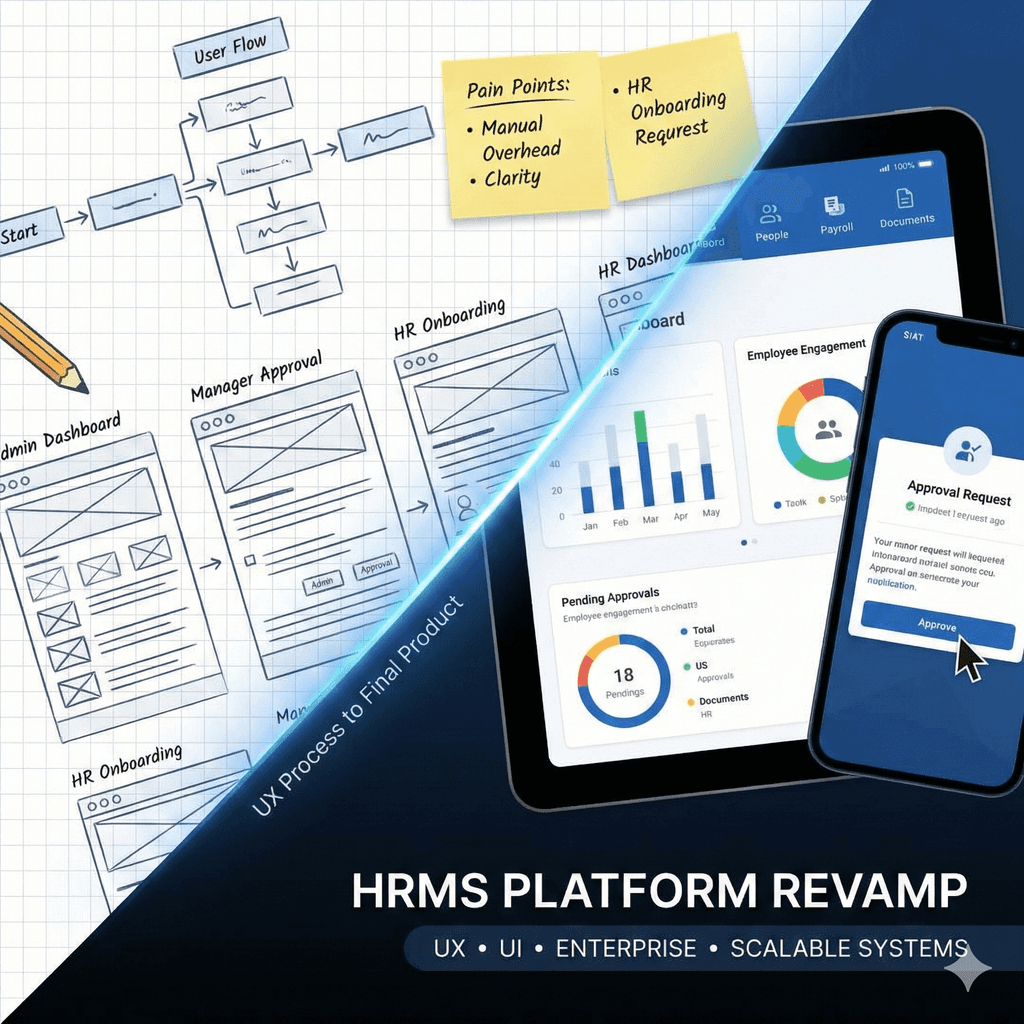
Delivered role-based HRMS redesign that streamlined onboarding, approvals, and evaluations through scalable UX patterns and reduced manual HR workload.
Year :
2024
Industry :
Event / Festival
Client :
FestivalWorks
Project Duration :
6 weeks
Problem :
Role Ambiguity: HR, Manager, and Admin shared the same UI, leading to unclear responsibilities, duplicated tasks, and unnecessary follow-ups.
Scattered Workflows: Onboarding, approvals, evaluations, and documents operated across disconnected flows, causing delays and confusion.
Manual Coordination Load: Frequent status checks, document requests, and approval reminders increased HR’s operational overhead.
Poor Task Visibility: Users lacked insight into task ownership, progression, and pending actions.
Policy + System Mismatch: HR policies, compliance rules, and permissions were not reflected in the product experience.
No Scalable Patterns: Adding new workflows or roles required custom UI, making the system harder to scale or maintain.

Solution :
To address this, a vibrant and cohesive set of promotional materials was developed, including posters, flyers, and social media graphics. The campaign leveraged bold, sun-soaked color palettes, playful typography, and dynamic imagery that captured the essence of summer fun.
Consistent visual elements and messaging were used across all materials to reinforce the festival’s brand identity and create a unified, easily recognizable look. The designs were tailored for both print and digital platforms, ensuring maximum reach and adaptability.


Challenge :
Domain Complexity
HR policies differed between onboarding, evaluation, and documents
Edge cases in permissions (e.g., Manager vs Admin access rules)
Role Conflict
Balancing shared modules while reducing UI clutter for each role
Verification Bottlenecks
Compliance-driven documents required clarity without overwhelming UI
Technical Constraints
Data models + existing backend workflows limited UI transitions
Iteration Feedback Loops
HR + Admin stakeholders prioritized different problem areas
Required negotiation on task priorities vs user convenience
Summary :
Redesigned the HRMS with benchmark research from Greythr and domain analysis of role-specific workflows. Introduced permission-based UX, guided onboarding, approval tracking, and reusable interface patterns. Improved alignment between HR policies and product logic, reducing manual coordination while enabling clearer ownership, visibility, and task accountability across HR, Manager, and Admin roles.


More Projects






UI / UX Design
HRMS
Delivered role-based HRMS redesign that streamlined onboarding, approvals, and evaluations through scalable UX patterns and reduced manual HR workload.
Year :
2024
Industry :
Event / Festival
Client :
FestivalWorks
Project Duration :
6 weeks
Problem :
Role Ambiguity: HR, Manager, and Admin shared the same UI, leading to unclear responsibilities, duplicated tasks, and unnecessary follow-ups.
Scattered Workflows: Onboarding, approvals, evaluations, and documents operated across disconnected flows, causing delays and confusion.
Manual Coordination Load: Frequent status checks, document requests, and approval reminders increased HR’s operational overhead.
Poor Task Visibility: Users lacked insight into task ownership, progression, and pending actions.
Policy + System Mismatch: HR policies, compliance rules, and permissions were not reflected in the product experience.
No Scalable Patterns: Adding new workflows or roles required custom UI, making the system harder to scale or maintain.
Solution :
To address this, a vibrant and cohesive set of promotional materials was developed, including posters, flyers, and social media graphics. The campaign leveraged bold, sun-soaked color palettes, playful typography, and dynamic imagery that captured the essence of summer fun.
Consistent visual elements and messaging were used across all materials to reinforce the festival’s brand identity and create a unified, easily recognizable look. The designs were tailored for both print and digital platforms, ensuring maximum reach and adaptability.
Challenge :
Domain Complexity
HR policies differed between onboarding, evaluation, and documents
Edge cases in permissions (e.g., Manager vs Admin access rules)
Role Conflict
Balancing shared modules while reducing UI clutter for each role
Verification Bottlenecks
Compliance-driven documents required clarity without overwhelming UI
Technical Constraints
Data models + existing backend workflows limited UI transitions
Iteration Feedback Loops
HR + Admin stakeholders prioritized different problem areas
Required negotiation on task priorities vs user convenience
Summary :
Redesigned the HRMS with benchmark research from Greythr and domain analysis of role-specific workflows. Introduced permission-based UX, guided onboarding, approval tracking, and reusable interface patterns. Improved alignment between HR policies and product logic, reducing manual coordination while enabling clearer ownership, visibility, and task accountability across HR, Manager, and Admin roles.
More Projects
UI / UX Design
HRMS
Delivered role-based HRMS redesign that streamlined onboarding, approvals, and evaluations through scalable UX patterns and reduced manual HR workload.
Year :
2024
Industry :
Event / Festival
Client :
FestivalWorks
Project Duration :
6 weeks
Problem :
Role Ambiguity: HR, Manager, and Admin shared the same UI, leading to unclear responsibilities, duplicated tasks, and unnecessary follow-ups.
Scattered Workflows: Onboarding, approvals, evaluations, and documents operated across disconnected flows, causing delays and confusion.
Manual Coordination Load: Frequent status checks, document requests, and approval reminders increased HR’s operational overhead.
Poor Task Visibility: Users lacked insight into task ownership, progression, and pending actions.
Policy + System Mismatch: HR policies, compliance rules, and permissions were not reflected in the product experience.
No Scalable Patterns: Adding new workflows or roles required custom UI, making the system harder to scale or maintain.
Solution :
To address this, a vibrant and cohesive set of promotional materials was developed, including posters, flyers, and social media graphics. The campaign leveraged bold, sun-soaked color palettes, playful typography, and dynamic imagery that captured the essence of summer fun.
Consistent visual elements and messaging were used across all materials to reinforce the festival’s brand identity and create a unified, easily recognizable look. The designs were tailored for both print and digital platforms, ensuring maximum reach and adaptability.
Challenge :
Domain Complexity
HR policies differed between onboarding, evaluation, and documents
Edge cases in permissions (e.g., Manager vs Admin access rules)
Role Conflict
Balancing shared modules while reducing UI clutter for each role
Verification Bottlenecks
Compliance-driven documents required clarity without overwhelming UI
Technical Constraints
Data models + existing backend workflows limited UI transitions
Iteration Feedback Loops
HR + Admin stakeholders prioritized different problem areas
Required negotiation on task priorities vs user convenience
Summary :
Redesigned the HRMS with benchmark research from Greythr and domain analysis of role-specific workflows. Introduced permission-based UX, guided onboarding, approval tracking, and reusable interface patterns. Improved alignment between HR policies and product logic, reducing manual coordination while enabling clearer ownership, visibility, and task accountability across HR, Manager, and Admin roles.